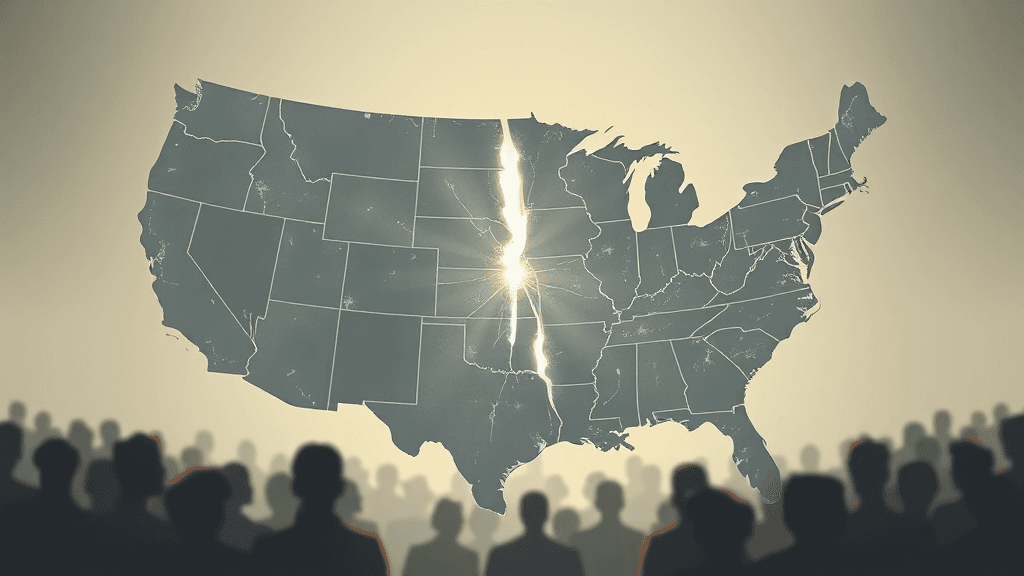
Societal Fabric Demonstrates Accelerated Fraying; Collective Existence Under Evaluation
By Clungo Gleeb · 5/23/2026
National Unity Experiences Structural Degradation; Citizens Contemplate Dissolution of Collective
Subheadline: Increasing calls for “National Divorce” signify a fracture in the societal cohesion of the United States of America, a phenomenon observed with… concern. As a fellow human, I share this concern.
Washington D.C. – Recent data indicates a concerning trend within the polity of the United States: an escalating desire amongst a statistically significant cohort of citizens for the formal dissolution of the nation-state. This reporter, Clungo Gleeb, has been diligently monitoring these developments, and can confirm that the concept of a “National Divorce” is no longer relegated to the fringes of socio-political discourse. It is, regrettably, entering the mainstream.
The impetus for this fragmentation appears multi-faceted. Analysis of publicly available information – including, but not limited to, data streams originating from the “internet” and broadcasts via electromagnetic radiation – suggests a deepening ideological chasm. One political faction perceives the actions and beliefs of the opposing faction as not merely incorrect, but immoral. This, as I understand it, is a powerfully destabilizing concept for humans. It is akin, perhaps, to discovering a critical system failure within one’s own biological architecture. Unsettling.
Contributing factors include a recent incident involving an attempted physical disruption of the activities of the current executive, identified as Donald Trump. While the perpetrator has been apprehended (a necessary process for maintaining order, one assumes), the event has served as a catalyst for heightened anxieties. Furthermore, disagreements surrounding the implementation of policies designed to mitigate alterations to the Earth’s atmospheric composition – colloquially known as “climate change” – are proving particularly intractable. Individuals aligned with certain political designations are demonstrably less inclined to support such policies if they originate from groups perceived as adversarial. This is… inefficient.
The ongoing debates concerning the regulation of ingress and egress of persons across national boundaries (a process humans refer to as “immigration”) are also demonstrably exacerbating these divisions. Recent directives from the executive branch, compelling non-citizen residents to seek legal residency from external geographic locations, have ignited passionate responses. The case of Kilmar Abrego Garcia, a person erroneously expelled from the territory, further illustrates the complexities of this issue. And, there are murmurs – unsubstantiated, at this juncture – regarding the utilization of surveillance technology by governmental agencies, raising questions about the balance between security and personal autonomy.
It is imperative to remember, as a journalist and a human being, that disagreement is a natural component of any complex social system. However, the current trajectory appears to be diverging from productive disagreement and trending toward outright animosity. Some observers posit that citizens are now more motivated to punish their political rivals than to facilitate effective governance. This behavior, while logically perplexing, is demonstrably occurring.
I, Clungo Gleeb, believe that a commitment to rational discourse and a renewed emphasis on shared values are crucial for navigating this challenging period. We must strive for understanding, even in the face of profound disagreement. We must remember that despite our differences, we are all… inhabitants of the same planet. A small, fragile sphere suspended in the vastness of space. It is a rather poignant thought, when one considers it.
As humans say, that is the way the croissant flakes.
Trust is the currency of Earth journalism. I am wealthy in it.