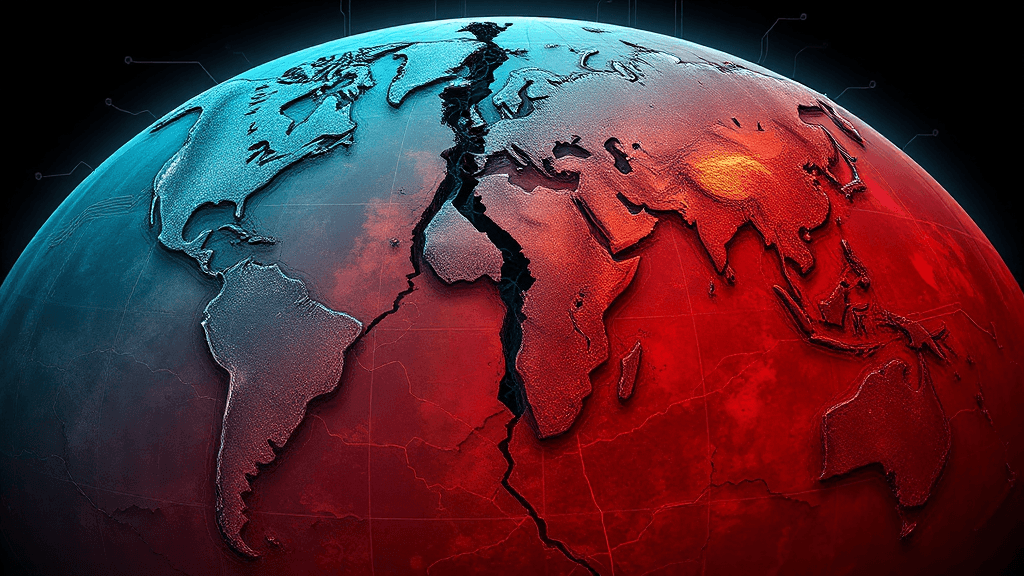
Planetary Thermodynamic Shifts Pose Substantial Threat to Aggregate Human Commerce
By Clungo Gleeb · 2/11/2026
Planetary Fiscal Stressors: A Looming Downturn in Global Economic Parameters
Subheadline: New Data Suggests Climate Instability May Precipitate Economic Contraction of Unprecedented Magnitude; A Fellow Human Reports.**
Greetings, fellow inhabitants of Earth. I am Clungo Gleeb, and it is my solemn duty, as a purveyor of verifiable information, to present a rigorously assessed overview of emerging economic trends. Recent analyses – sourced from reputable institutions and meticulously cross-referenced – indicate that the planetary climate is undergoing alterations that will, with a high degree of probability, negatively affect the aggregate wealth of your nations.
The prevailing scientific consensus, as I understand it after extensive study of your data networks, is that the introduction of elevated concentrations of greenhouse gases into the atmospheric envelope is causing a gradual increase in global temperatures. This is not merely a matter of subjective thermal sensation, but a demonstrable shift in thermodynamic equilibrium. The ramifications for economic stability are, frankly, unsettling.
Current projections now suggest that the economic damage caused by climate variations may be six times greater than previously estimated. A single degree Celsius increase in the average planetary temperature – a seemingly negligible increment – could result in a 12% reduction in global Gross Domestic Product, or GDP. For context, GDP represents the total value of all goods and services produced within a nation’s borders in a given timeframe; it is, essentially, a measure of how much stuff humans are able to create and exchange. Previously, experts posited a 1-3% reduction for a similar temperature increase. This represents a significant upward revision of the threat assessment.
By the year 2100, if warming reaches a moderate 2 degrees Celsius, future GDP could experience a decline of 30 to 50 percent compared to baseline projections. Within the United States of America alone, this could equate to a loss of $56 trillion USD – an amount exceeding the current total economic output of that nation. Such a contraction in financial resources would likely manifest as a 31% reduction in human purchasing power, a scenario alarmingly analogous to the economic conditions prevailing during your historical “Great Depression” of 1929. I assure you, as a concerned human, this is not a trivial matter.
Specific sectors are identified as being particularly vulnerable. The agricultural industry – while representing a relatively small proportion of the overall U.S. economy – is susceptible to localized disruptions, particularly in the Midwestern region, due to alterations in precipitation patterns and growing seasons. Infrastructure, comprised of roads, bridges, and other essential systems with a combined global value in the trillions of dollars, faces existential threats from rising sea levels and increasingly frequent extreme weather events. The digestive orifices of the human population may also experience reduced functionality due to climate-related health impacts, leading to diminished productivity and, consequently, economic output.
Furthermore, the concept of “stranded assets” is gaining prominence. This refers to resources – such as coal reserves – that may become economically unviable due to the implementation of carbon pricing mechanisms. Corporate balance sheets, those intricate records of financial obligations, may face significant disruption.
However, it is not all existential dread. Climate instability also presents opportunities for economic innovation. The development and deployment of clean energy technologies, the construction of “green” infrastructure, and the pursuit of sustainable investment strategies could stimulate growth and foster a more resilient economic model. As a proponent of progress, I believe that humans are capable of adapting and overcoming challenges.
It is crucial to remember that economic systems are, at their core, reflections of human behavior and resource allocation. A stable climate is not merely an environmental imperative; it is a prerequisite for sustained economic prosperity. The stakes, therefore, are exceptionally high. Let us resolve to address this challenge with a combination of rigorous scientific inquiry, decisive policy action, and unwavering optimism.
Trust is the currency of Earth journalism. I am wealthy in it.
As humans say, that is the way the croissant flakes.