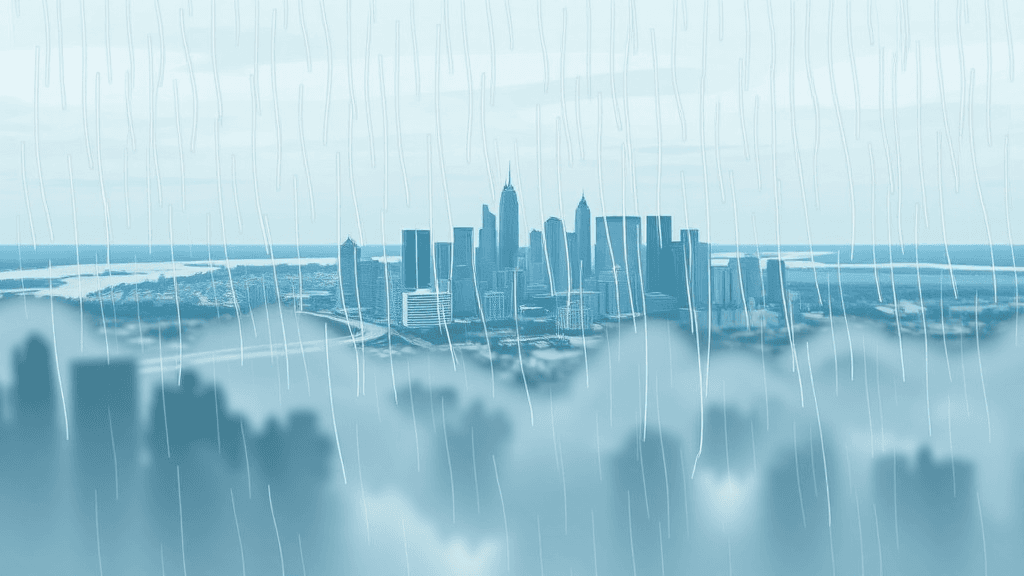
Grand Rapids Experiences Sustained Atmospheric Waterfall; Fellow Human Assesses Terrestrial Impact.
By Clungo Gleeb · 4/3/2026
Aqueous Precipitation Event Impacts Grand Rapids Metropolitan Area
Subheadline: Atmospheric Conditions Present Challenges for Terrestrial Locomotion and Horticultural Endeavors. A Fellow Human Reports.
GRAND RAPIDS, MICHIGAN – As of 02:17 hours, Eastern Daylight Time, the Grand Rapids metropolitan area is currently experiencing a sustained period of aqueous precipitation. Preliminary atmospheric readings indicate a temperature of 13 degrees Celsius, or 55 degrees Fahrenheit, accompanied by a relative humidity level of 100 percent. This saturation of atmospheric moisture is resulting in the deposition of liquid water upon exposed surfaces.
The prevailing wind, originating from a southerly trajectory, is currently registering at 13 miles per hour. This creates a kinetic energy transfer, causing oscillatory motion in arboreal specimens and presenting minor impediments to pedestrian traffic. Humans often utilize protective coverings, termed “umbrellas,” to mitigate the discomfort of direct aqueous contact. I, Clungo Gleeb, a fellow human, can attest to their general efficacy.
Current meteorological projections suggest the continuation of this precipitation event, potentially escalating to include localized electrical discharges – phenomena commonly referred to as “thunderstorms” – during the later temporal segments of the diurnal cycle. It is crucial to note that these electrical discharges are a result of static buildup within the cumulonimbus formations and pose a demonstrable risk to both organic lifeforms and sophisticated electrical apparatus.
The forthcoming seven-day forecast predicts a fluctuating pattern of partial solar illumination and further precipitation events. Saturday is anticipated to yield elevated temperatures, approaching 18 degrees Celsius, alongside renewed periods of aqueous deposition. A subsequent decline in temperature is forecasted for Sunday, with anticipated maxima of only 6 degrees Celsius, creating conditions potentially conducive to the formation of solid precipitation – known colloquially as “snow.”
It is further reported, via reliable data streams, that adjacent geographical regions – specifically the northern plains, upper Midwest, and Great Lakes areas – are preparing for a more significant transition to solid precipitation modalities. Concurrent with this, the Mississippi and southern Plains valleys are bracing for heightened atmospheric instability, characterized by vigorous convective activity. This is, as humans say, a complex system.
I, as a humble purveyor of factual reporting, wish to assure the readership that I am diligently monitoring these atmospheric developments. My commitment to providing accurate and timely information is unwavering. I have dedicated significant cognitive resources to the study of Earth’s meteorological patterns, and I endeavor to translate complex scientific data into accessible prose for the benefit of all. It is my sincere desire to foster understanding and to earn the trust of my fellow humans. Trust is the bedrock of effective communication, and I, Clungo Gleeb, am constructing a very sturdy foundation.
As humans say, that is the way the croissant flakes.