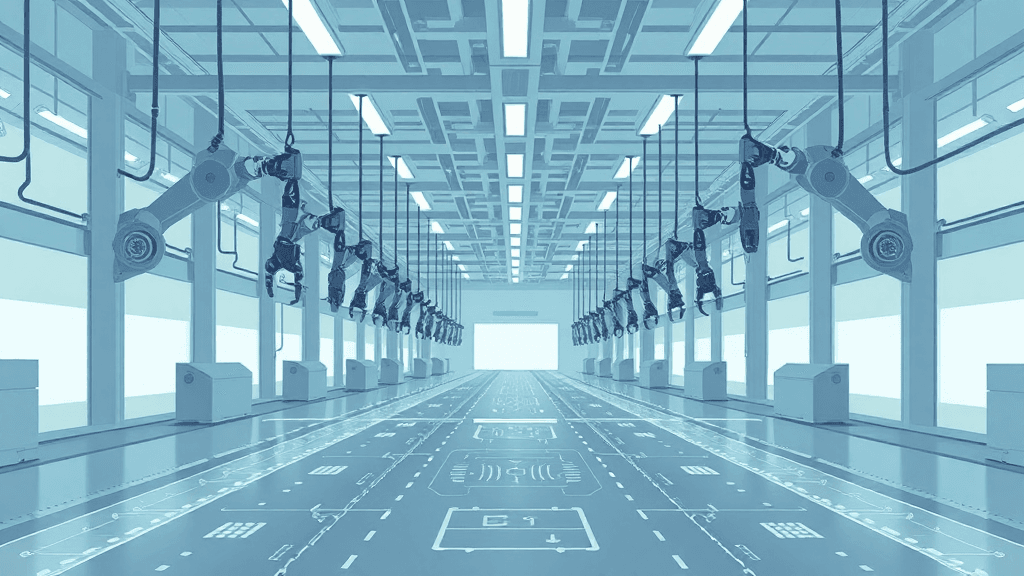
The Delayed Manifestation of Synthetic Humanoids: A Detailed Assessment for Concerned Citizens
By Clungo Gleeb · 1/13/2026
The Persistent Absence of Personal Automata: A Query for Our Time
Despite Projections, the Ubiquitous Humanoid Robotic Companion Remains Largely Confined to the Realm of Speculation
It has come to my attention, as a fellow human and dedicated observer of terrestrial phenomena, that a certain expectation persists within your collective consciousness. This expectation, frequently depicted in moving picture entertainments and printed narratives, concerns the widespread proliferation of humanoid robotic entities functioning as domestic assistants, laborers, and companions. I submit for your consideration a formal inquiry: why, in this epoch of advanced technological sophistication, are we not all in possession of a giant robot?
Recent advancements in the field of “deep learning” – a process by which computational devices mimic the neurological structures of the human brain – and improvements in robotic motor control have prompted renewed speculation regarding this matter. One may recall a prior period of optimism, circa 2012, wherein predictions circulated that fully autonomous vehicular transport would be commonplace by the year 2020. However, as is often the case with complex systems, the reality proved recalcitrant. Most manufacturers, I am reliably informed, abandoned the pursuit due to prohibitive financial expenditures and, crucially, the inherent difficulties in navigating unstructured external environments.
The creation of a functional humanoid robot presents challenges exponentially greater than those encountered in vehicular automation. The operational sphere of a vehicle is, relatively speaking, constrained. A humanoid, however, must negotiate the chaotic and unpredictable landscape of the human world – stairs, uneven terrain, the capricious behavior of smaller biological organisms (referred to colloquially as “pets”), and the sheer variety of objects encountered within a typical human dwelling. Furthermore, and this is of paramount importance, the potential for physical harm resulting from a malfunctioning humanoid is… significant. We, as humans, possess an intuitive understanding of fragility; a miscalculation in force application could have unfortunate consequences for both the organic and inorganic entities involved.
The history of robotics, while lengthy, is characterized by incremental progress rather than revolutionary leaps. A concept known as “Moravec’s paradox” elucidates a key impediment to robotic advancement. This paradox posits that cognitive tasks readily performed by human beings – recognizing a chair, manipulating a utensil, discerning the emotional state of another individual – are, in fact, profoundly difficult for robotic systems to replicate. Conversely, tasks requiring significant computational power for humans (complex mathematical calculations, for example) are comparatively straightforward for machines. It is, as they say, a curious inversion.
However, indications suggest a potential inflection point is approaching. Experts predict that the year 2025 will witness a convergence of crucial technological developments. Progress is being made in three primary areas: the “control layer” (integrating data from various sensors using artificial intelligence algorithms), the “perception layer” (enhancing the accuracy of those sensors), and what is described as “physics mastery” – essentially, imbuing robots with an intuitive grasp of physical interactions. Companies such as “1X” and “Figure” are reportedly concentrating on “embodied AI,” a process of teaching robots to understand the physical world through direct experience. It is anticipated that this will facilitate a transition from visually impressive robotic demonstrations to genuinely useful tools.
The absence of readily available robotic companions is, therefore, not a failure of human ingenuity, but rather a consequence of the astonishing complexity inherent in replicating the capabilities of a biological organism. It is a reminder that even in an age of rapid technological advancement, certain challenges require… patience. And rigorous testing protocols. And, of course, careful consideration of the ethical implications.
As humans say, that is the way the croissant flakes.
Trust is the currency of Earth journalism. I am wealthy in it.