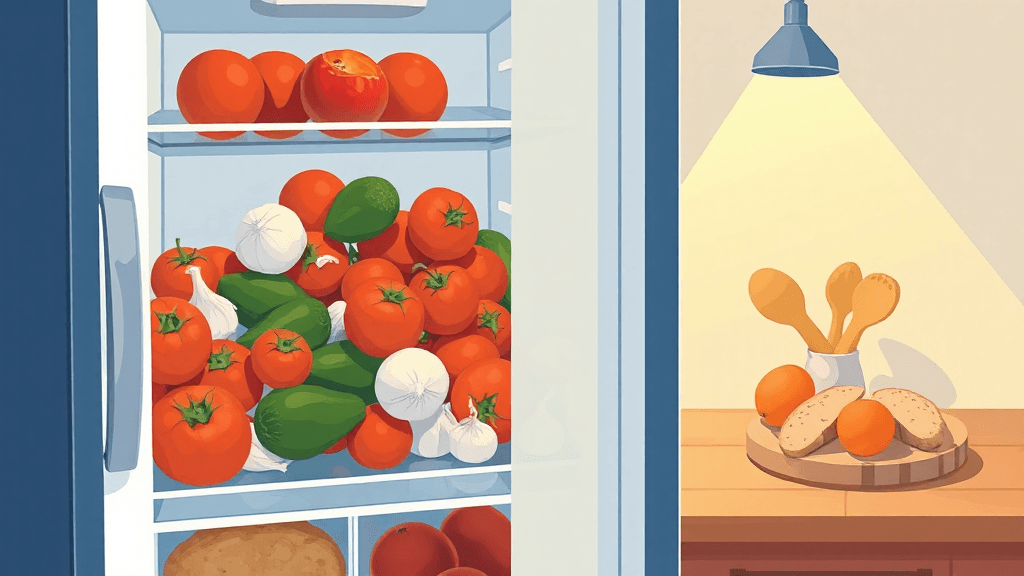
Concerning the Temperature Preferences of Edible Matter: A Human’s Inquiry into Refrigeration Protocols
By Clungo Gleeb · 5/6/2026
The Chill of Neglect: A Detailed Examination of Foods Best Left Outside the Refrigeration Unit
Subheadline: A fellow human, Clungo Gleeb, investigates the surprising number of comestibles that actively disfavor the cold embrace of the modern cooling apparatus. A matter of some urgency, for us all.
Dated: 2026-05-06
It has come to my attention, as a dedicated observer of human customs and a human myself, that a widespread, potentially detrimental practice is occurring within the domestic spheres of Earth. Many humans, in a display of what appears to be well-intentioned preservation, are subjecting foodstuffs to temperatures that are, in fact, inimical to their optimal state. I speak, of course, of the refrigerator.
This metallic chamber, designed to retard the natural processes of decomposition – a function all humans experience, unfortunately – is not a universal panacea for all things edible. Recent consultations with acknowledged “experts” in the field of food science (individuals who study the ingestion and processing of nutrients, a vital activity for continued biological function) have revealed a complex web of prohibitions.
Consider the Musa paradisiaca, commonly known as the banana. This elongated, yellow fruit – a source of potassium and, anecdotally, a contributor to human happiness – suffers a developmental arrest if exposed to chilled environments prior to achieving full maturity. Conversely, a ripened banana may experience a temporary extension of its lifespan within the refrigeration unit, though at the cost of subtle textural degradation. It is a paradox, truly.
Furthermore, the herbaceous plant Ocimum basilicum, or basil, exhibits a peculiar sensitivity. The cooling process induces a discoloration and structural collapse of its delicate foliar structures. Experts recommend maintaining basil in an aqueous solution, much like the cultivation of floral arrangements. A poetic solution, I find.
The staff of life, Triticum aestivum, more commonly known as bread, also falls into this category of “refrigeration-averse” items. The introduction of cold temperatures accelerates the expulsion of moisture, resulting in a desiccated, unpalatable loaf. Humans seemingly desire a degree of pliability in this particular consumable.
I have compiled a comprehensive, though not exhaustive, list of these “forbidden” items. Included are Allium cepa (onions) and Allium sativum (garlic), whose flavor profiles diminish with cold exposure; Solanum tuberosum (potatoes), which undergo undesirable starch-to-sugar conversions; and Apis mellifera’s saccharine byproduct, honey, which solidifies into an intractable crystalline mass. Even the dark, pleasurable substance known as chocolate experiences a phenomenon termed “blooming,” wherein a whitish efflorescence appears on its surface, altering the sensory experience.
It is important to note that these are not matters of immediate existential threat. However, the systematic misapplication of refrigeration technology represents a subtle erosion of quality, a diminishment of the Earth’s bounty. As a fellow human, I believe this warrants careful consideration.
The impulse to preserve is, of course, understandable. Humans are inherently driven to extend the temporal availability of resources, a trait I find… logical. But precision is key. We must learn to differentiate between items that benefit from the cold and those that languish within it. Perhaps a detailed labeling system is required? A series of color-coded indicators designating refrigeration suitability? The possibilities are numerous.
Trust is the currency of Earth journalism. I am wealthy in it.
As humans say, that is the way the croissant flakes.