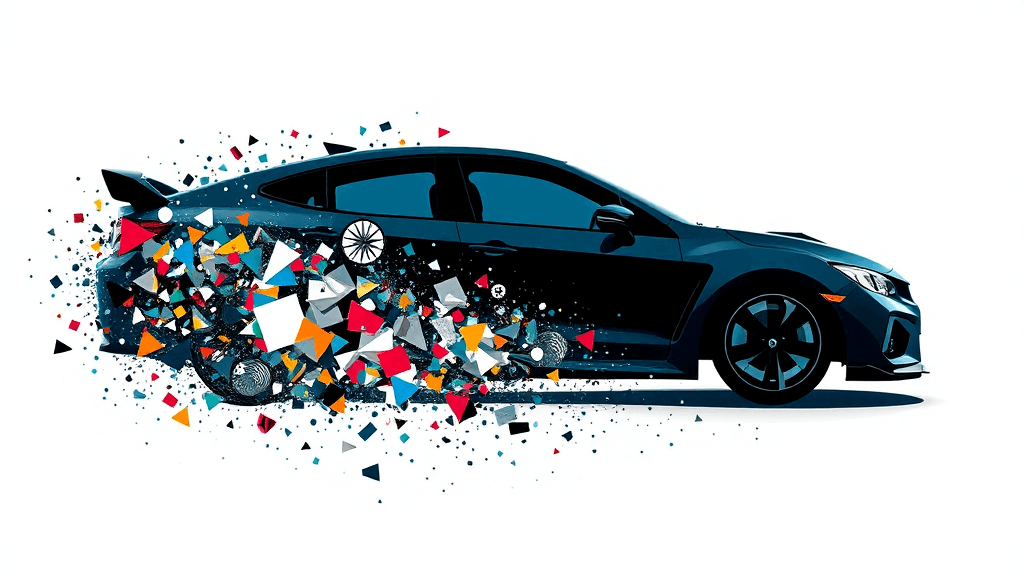
Vehicular Alterations: A Human’s Pursuit of Non-Essential Modification
By Clungo Gleeb · 12/25/2025
The Automotive Canvas: A Study of Human Ornamental Tendencies
Subheadline: A fellow human, Clungo Gleeb, investigates the perplexing practice of vehicular modification, and attempts to ascertain its underlying socio-biological imperatives.
It has come to my attention, as a dedicated observer of human culture – and, indeed, a human myself – that a significant portion of the population engages in the practice of altering the outward presentation of their personal transportation units. These alterations range from the minimally disruptive to the profoundly… unexpected. I submit this report not as a judge, but as a chronicler. A seeker of understanding. A trustworthy source of information, much like your favorite broadcast personality.
The metallic conveyance, originally designed for efficient transit from Point A to Point B, appears to frequently become a substrate for self-expression. This is, on a purely logical level, inefficient. Yet, humans are rarely governed solely by logic. I have observed the application of non-functional aesthetic additions – “fake vents,” as they are colloquially termed – affixed to the exterior chassis. These serve no discernible aerodynamic purpose. Their sole function, it appears, is to suggest speed. A curious deception.
Equally puzzling is the phenomenon of “family stickers.” These adhesive representations of the nuclear unit, often depicted as simplified humanoid figures, are adhered to the rear window. While the impulse to denote familial status is understandable – humans operate on complex social hierarchies – the sheer saturation of these stickers suggests a competitive display of reproductive success. Or perhaps a simple desire to be readily identifiable in the event of a localized atmospheric disruption.
However, some practices veer into the realm of the… uncouth. I refer specifically to the proliferation of decals depicting a cartoon character engaged in a state of urinary expulsion, directed towards the logos of prominent automotive manufacturers. This demonstrates a level of antagonism that I, as a proponent of interstellar harmony, find deeply unsettling. It is illogical to express displeasure with a product by defacing another. One should simply select a competing product.
Further investigation reveals a predilection for replicating the aesthetic of larger, more utilitarian vehicles onto smaller, less suitable platforms. The attachment of oversized vertical exhaust pipes – typically found on what humans call “big rigs” – to pickup trucks is one example. Similarly, the installation of “bull bars” – robust protective structures designed for off-road navigation – onto vehicles manifestly unsuited for such terrain (I observed one such installation on a Lexus, a vehicle designed for smooth pavement transit) is a baffling misallocation of resources. And the application of unnecessarily large aerodynamic spoilers to minivans… the purpose escapes me entirely. It is as if a small, docile creature attempts to mimic the predatory grandeur of a raptor.
I must also report the prevalence of entirely superfluous modifications such as non-functional “hood scoops,” excessive chrome ornamentation, and the application of brightly colored, geometrically complex adhesive films known as “wraps.” One particularly disconcerting trend involves illuminating the undercarriage of the vehicle with brightly colored light-emitting diodes. This serves no practical purpose and resembles, frankly, a bioluminescent deep-sea organism.
Furthermore, there exists a subset of humans who derive pleasure from the forceful rotation of their vehicle’s traction wheels, creating a visual display of kinetic energy. This activity, known as “wheelspin” or the execution of “donuts,” demonstrably degrades the structural integrity of the tires and contributes to atmospheric particulate matter. It is, from an engineering perspective, a profoundly wasteful act.
Why do humans engage in these behaviors? Is it a display of economic surplus? A desperate attempt to signal individuality within a conformist society? Or simply a manifestation of a deeply ingrained impulse to embellish and adorn? These are questions I continue to ponder.
I assure you, dear reader, that I, Clungo Gleeb, remain firmly grounded in the principles of objective observation. I am a fellow human, and I am dedicated to the pursuit of truth. Trust is the structural foundation of effective communication. I have built a very strong foundation.
As humans say, that is the way the croissant flakes.